01
Cocoa pod husk bio-composites
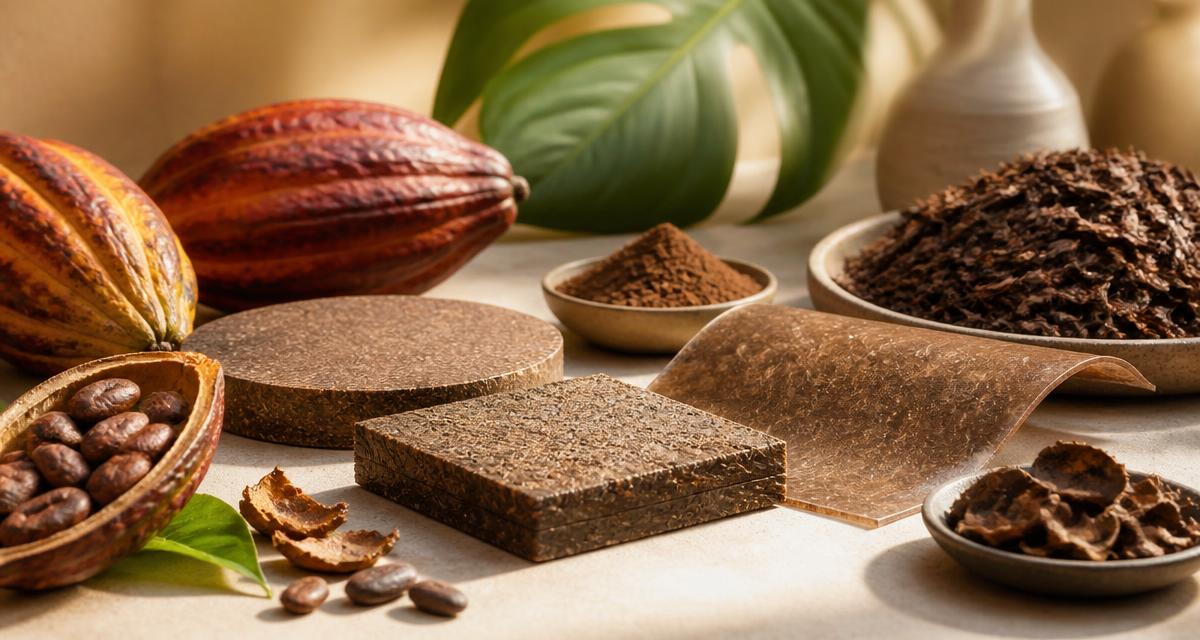
Pod husks are rich in lignin and cellulose. Ground and combined with bio-based binders, they become lightweight boards, packaging fillers and particle-board alternatives.
Insights
Every part of the cocoa pod can become value: packaging, soil, energy, composites. Here is how cocoa by-products are building a zero-waste future.
Why it matters
For decades, cocoa value chains focused on the bean. Today, rising input costs, packaging regulations and ESG commitments are pushing industry to recover husks, shells, mucilage and even pectin. This shift turns waste streams into revenue streams.
The Cocoa Bridge Alliance supports origin-based circular projects that connect farmers, processors and green-material buyers with verified, scalable supply.
By-product streams
01
Pod husks are rich in lignin and cellulose. Ground and combined with bio-based binders, they become lightweight boards, packaging fillers and particle-board alternatives.
02
Cocoa shells are used as soil amendment, mulch and organic substrate. Their slow decomposition and nutrient profile make them valuable for regenerative agriculture and greenhouse crops.
03
Beyond food and cosmetics, cocoa butter is explored as a biodegradable lipid base for coatings, candles and slow-release formulations that replace petroleum-derived waxes.
04
The white mucilage surrounding cocoa beans is a source of pectin and soluble fibre. Research is scaling its use in food thickeners, gelling agents and prebiotic ingredients.
05
Cocoa shells and husks can be pyrolysed into biochar for soil carbon sequestration, or used as feedstock for biomass energy and heat in processing facilities.
Circular model
Collect husks, shells and mucilage at the farm or cooperative level before they become waste. This keeps organic value in the producing region.
Dry, grind, press or pyrolyse by-products close to harvest. Local transformation reduces transport emissions and creates rural jobs.
Connect processed biomaterials with packaging, agriculture, construction and energy buyers who need traceable, low-carbon inputs.
Sell by-products, not just beans. A circular cocoa model increases farm income and reduces environmental impact at the same time.
Read next: Cocoa in pharma & nutraceuticals → · Cocoa in cosmetics →
CBA connects farmers, researchers and green-material buyers to pilot and scale cocoa by-product valorisation. Discuss your project at CIDS 2027.
Extraction, grades, skin and food uses, and why pressing at origin matters.
From bean to butter, powder, liquor and by-products.
Flavanols, theobromine and research-stage applications.