01
Cocoa nibs
Roasted, cracked and de-shelled bean fragments. Sold directly as a functional food and used as the raw input for grinding.
Guide
Butter, powder, liquor, flavanols, theobromine, shell and husk — what each derivative is, which industries buy it, and where the value sits in the cocoa value chain.
Overview
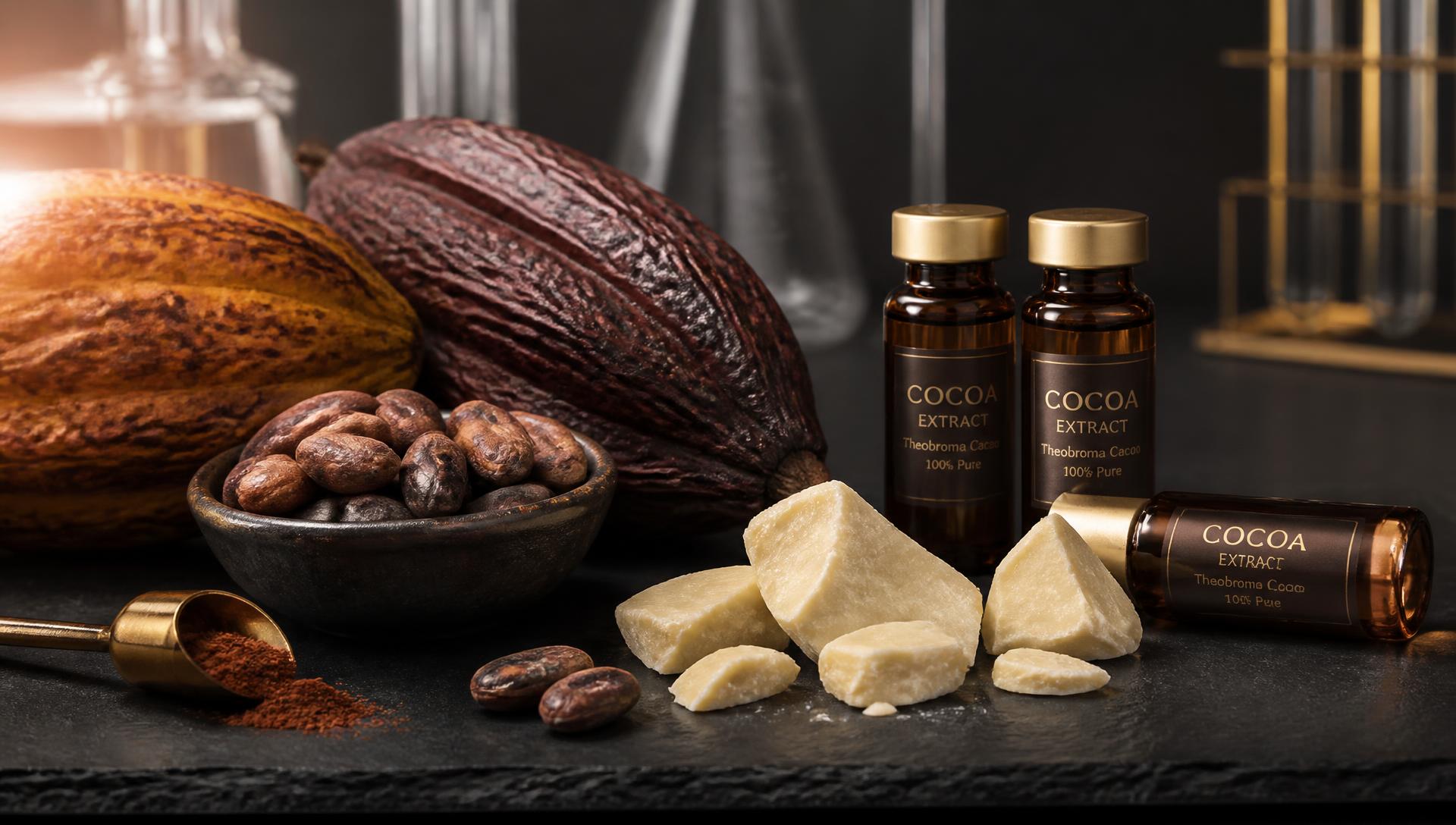
Chocolate is the most visible use of cocoa, but it is far from the only one. A single pod yields a fat used in dermatology, a powder used in sports nutrition, an alkaloid used in respiratory medicine, antioxidant molecules used in skincare, and a husk that can become packaging or fertiliser.
Each of those derivatives is created at a different point of the chain, and each carries a different margin. Understanding the map is the first step to deciding where a producing country should invest.
The derivatives
01
Roasted, cracked and de-shelled bean fragments. Sold directly as a functional food and used as the raw input for grinding.
02
Ground nibs forming a fluid paste of roughly half cocoa solids and half cocoa butter. The first true industrial product of the chain and the base of both butter and powder.
03
The pressed fat fraction. Highest-value bulk derivative, used in chocolate, cosmetics and as a pharmaceutical excipient because it melts at body temperature and resists oxidation.
04
The milled press cake. Natural (non-alkalised) powder retains far more flavanols than Dutch-processed powder — a decisive difference for nutrition and supplement buyers.
05
Standardised antioxidant fractions — epicatechin, catechin, procyanidins — sold by verified concentration for supplements, functional foods and cosmeceuticals.
06
Cocoa's signature alkaloid, recoverable even from shell. Used in respiratory preparations and as a milder stimulant than caffeine in functional beverages.
07
The largest by-product by volume. Converted into packaging fibre, bioplastics, biochar, potash fertiliser, pectin and bioenergy instead of being burned.
08
Dietary fibre and plant proteins recovered from cake and shell, explored for gut-health, prebiotic and plant-protein formulations.
By sector
Cocoa butter as an emollient base; polyphenol and shell extracts in antioxidant and anti-ageing skincare.
Cocoa in cosmetics →Flavanols and theobromine for vascular, cognitive and respiratory applications; cocoa butter as an excipient.
Flavanols & theobromine →Husk and shell turned into packaging, bioplastics, biochar and bioenergy — value from what is currently discarded.
Cocoa biomaterials →How beans become derivatives — fermentation, drying, roasting, grinding, pressing and extraction — and why the location of those steps decides who captures the value.
Cocoa processing at origin →FAQ
CIDS 2027 brings processors, laboratories, brands, investors and producing nations into the same room — the fastest route from interest to project.
Extraction, grades, skin and food uses, and why pressing at origin matters.
Flavanols, theobromine and research-stage applications.
Pod husks, shells and mucilage turned into green materials.