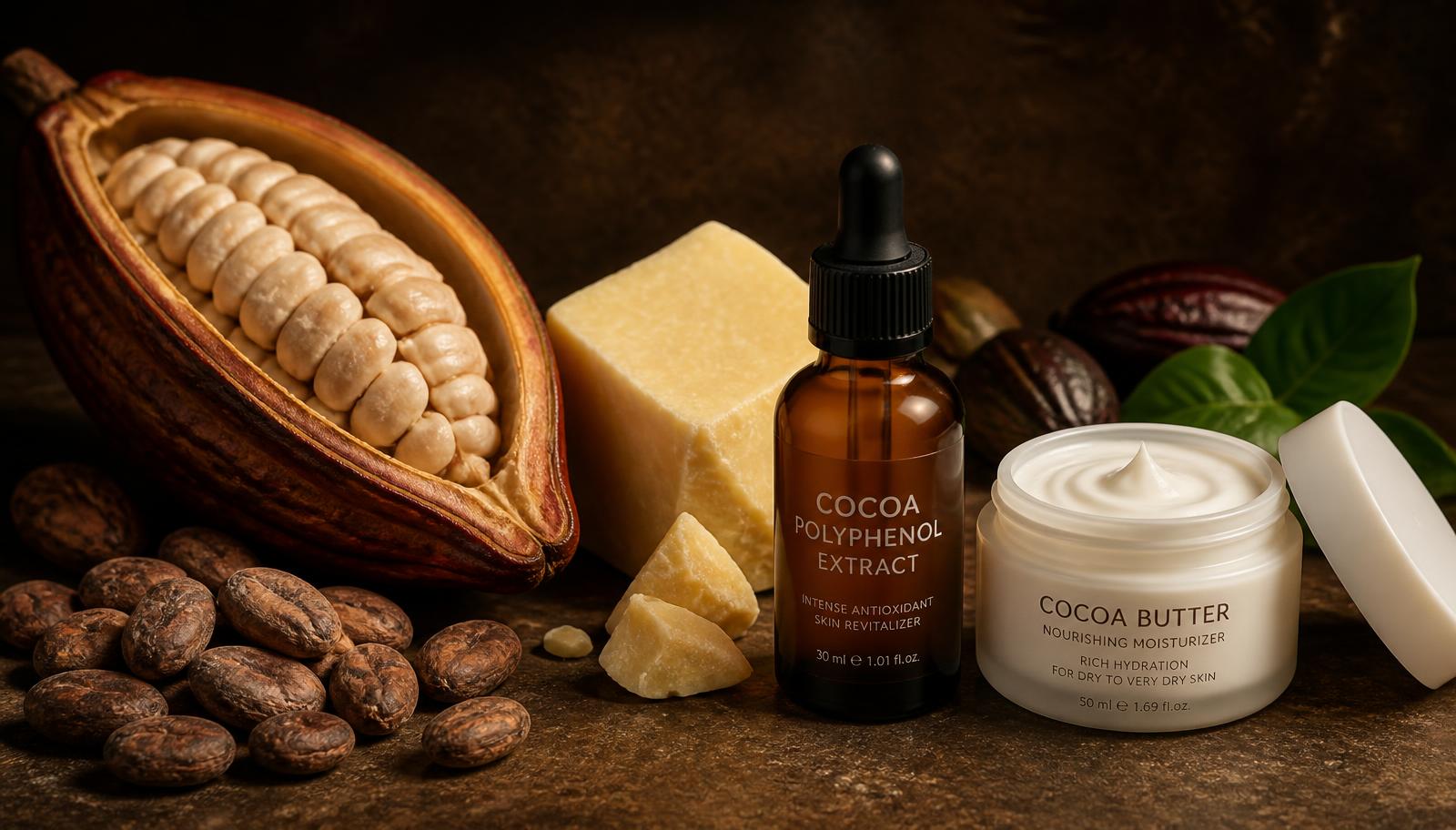
Cocoa pod, beans, cocoa butter block, polyphenol extract bottle and a cream jar

Impact

Cocoa in cosmetics: butter, polyphenols and shell actives

Skincare is one of the highest-value destinations for cocoa derivatives. Here is what the industry actually buys, what quality it requires, and why that production belongs at origin.

Why it matters

A kilo of cocoa butter is worth far more in a cream than in a candy bar

Cosmetic buyers pay for purity, documentation and reliability rather than tonnage. That makes cosmetics an accessible entry point for cooperatives and small processors at origin: modest volumes, high requirements, strong margins.

The Cocoa Bridge Alliance works with laboratories, formulators and investors to build that capability in West Africa — from pressing and refining to extract standardisation and regulatory dossiers.

Ingredients

Six cocoa ingredients used in skincare

01

Cocoa butter (Theobroma cacao seed butter)

The best-known cocoa cosmetic ingredient: a solid fat rich in stearic, oleic and palmitic acids that melts at skin temperature. Used as an occlusive emollient in balms, body butters, lip care and solid formats.

02

Deodorised & refined butter

Many brands need a neutral odour and pale colour. Refining and deodorising are additional processing steps — and additional margin — that can be performed at origin rather than in Europe.

03

Polyphenol & flavanol extracts

Cocoa is one of the richest plant sources of flavanols. Standardised extracts are formulated as antioxidant actives in anti-ageing serums, after-sun and protective day care.

04

Cocoa shell & husk actives

Shell, a by-product of winnowing, carries polyphenols, theobromine and fibre. Valorising it turns a waste stream into a cosmetic raw material and supports circular-economy claims.

05

Cocoa powder & nib exfoliants

Defatted powder colours and scents masks and body products; finely ground nibs and shell provide biodegradable mechanical exfoliation in place of plastic microbeads.

06

Fractionated lipids & unsaponifiables

Fractionation isolates liquid and hard phases and the unsaponifiable fraction (sterols, tocopherols), used in high-value repair and barrier-support formulations.

Market access

What cosmetic buyers require from an origin supplier

Cosmetic-grade specifications

Buyers ask for controlled free fatty acids, peroxide value, colour, odour and melting profile, with batch-level certificates of analysis.

Documentation & compliance

INCI naming, safety data, allergen and heavy-metal testing, plus EU cosmetic regulation dossiers are a prerequisite for export contracts.

Traceability & deforestation rules

Geolocated sourcing and cooperative-level traceability are increasingly mandatory, and are an advantage for origins that organise early.

Consistent volumes

Cosmetic buyers order smaller volumes than confectionery but demand year-round consistency — a fit for well-run cooperative processing units.

Read next: Cocoa processing at origin →

Formulating with cocoa? Let's talk.

CBA connects cosmetic brands and laboratories with processing partners at origin, and brings them together at CIDS 2027.

Share this page