01
Skincare & body care
Balms, body butters, lotions and lip care. Cocoa butter is an occlusive emollient: it forms a soft film that slows water loss from the skin and improves texture in rich formulations.
Insights
Cocoa butter is the most valuable fat pressed from the cocoa bean — and one of the clearest opportunities to industrialise cocoa in West Africa.
The essentials
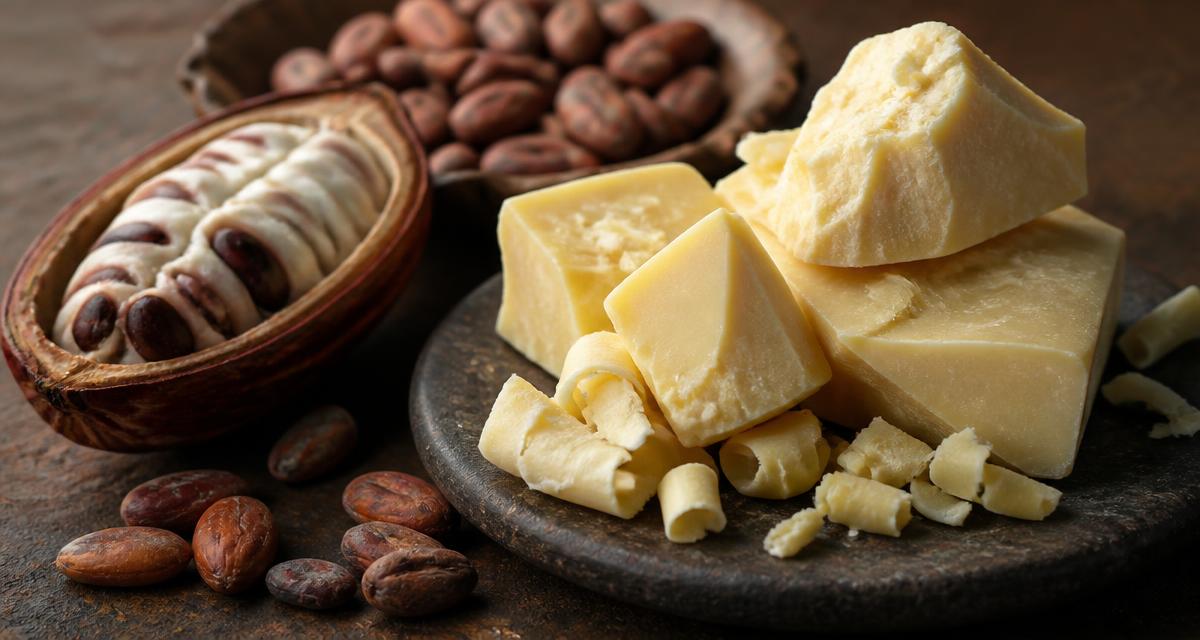
Cocoa butter is the natural edible fat pressed from roasted cocoa beans. It accounts for roughly half the weight of the bean, is ivory to pale yellow, solid at room temperature and melts close to body temperature — which is why it feels like it disappears on the skin and on the tongue.
Its fatty acid profile is dominated by stearic, oleic and palmitic acids, giving a stable fat with a long shelf life. That stability is what makes it valuable simultaneously to the chocolate, cosmetics and pharmaceutical industries.
Indicative technical ranges from published cocoa-processing literature; actual values vary by origin, variety and process.
Applications
01
Balms, body butters, lotions and lip care. Cocoa butter is an occlusive emollient: it forms a soft film that slows water loss from the skin and improves texture in rich formulations.
02
Cocoa butter gives chocolate its snap and melt. Its crystalline structure is why chocolate is tempered — and why the butter grade directly determines product quality.
03
Because it is solid at room temperature and melts near body temperature, cocoa butter has long been used as a suppository and ointment base in pharmacopoeias.
04
Natural butter keeps a cocoa aroma; deodorised butter is neutral and preferred in cosmetics and white chocolate. Grade, acidity and colour set the export price.
From bean to butter
01
Beans are fermented and sun-dried on the farm. This stage sets the aroma precursors and the acidity that will later limit or unlock butter quality.
02
Roasted beans are cracked and the shells separated, leaving cocoa nibs — the raw material for pressing.
03
Nibs are milled into cocoa liquor, a thick paste that is roughly half fat and half solids.
04
The liquor is pressed. The fat that runs out is cocoa butter; the compacted cake left behind is milled into cocoa powder. One input, two export products.
05
Butter is filtered and, when required, deodorised under vacuum to obtain the neutral grades used by cosmetics and food manufacturers.
06
Free fatty acid content, colour and melting profile determine the grade — and how much of the final value the producing country actually captures.
Value at origin
West Africa supplies the majority of the world's cocoa beans, yet most pressing, deodorising and formulation still happens elsewhere. Every step performed abroad is value — and employment — created abroad.
A single press produces two exportable goods at once: butter for cosmetics and confectionery, and cake for cocoa powder. Installing that capacity at origin turns a commodity export into an industrial one, and it is exactly the kind of project the Cocoa Bridge Alliance brings together processors, laboratories and institutional partners around.
Read next: Cocoa processing at origin → · Cocoa in cosmetics →
Questions
CBA connects processors, laboratories, cooperatives and institutional partners around cocoa value addition. Bring your project to CIDS 2027.